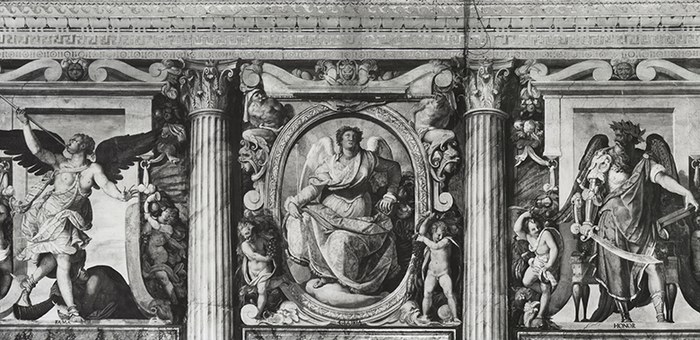
From the Federico Zeri Foundation’s databank you can consult the Julian Kliemann photo archive, a valuable resource providing scope for transversal research.
Here 16th-century Italian art is arranged by study topic, iconographic theme and monument cycle, breaking with the classification by author and school that is usual among connoisseurs’ photo archives.
Kliemann put together the earliest part of the collection while studying for the dissertation he presented at Heidelberg in 1974, which concerned the Leo Xth chamber and its decoration, the title being Politische und humanistische Ideen der Medici in der Villa Poggio a Caiano .
The frescoes by Jacopo Pontormo, Franciabigio and Andrea del Sarto are documented in countless detail, often juxtaposed with images for comparative purposes throwing light on the figurative content and its origins..
The lunette depicting Vertumno and Pomonais an apt case in point. From the extraordinary wealth of documentation one can reconstruct the gamut of artworks representingi Pomona, Etruscan goddess of the vegetable garden. The Pontormo fresco is accompanied by a woodcut from the Hypnerotomachia Poliphili, the opening page of a 16th-century play, an etching from a drawing by Perino del Vaga, and a plate from Vincenzo Cartari’s treatise on iconography.
The scene of Cicero’s Triumph is another case where, by way of newly discovered source material, Kliemann grouped various works portraying Cicero: a marble roundel from the Pavia Certosa, a small plaque, a woodcut by Ugo da Carpi.
The unusual pictorial theme of the giraffe is covered by another small sequence concerning Andrea del Sarto’s Caesar receives tribute from Egypt : a page from a medieval bestiary, an etching of a giraffe from the Archivio Chigiano, a detail of the animal from Moses and the gathering of manna by Bachiacca, a detail from the procession fresco by Filippino Lippi in S. Maria sopra Minerva. The whole sequence forms a visual dossier grouping together the potential sources open to the painter and his mentor for the project, Paolo Giovio. They included the exotic giraffe in the composition as an allusion to the ‘ideal’ continuity between Julius Caesar and Lorenzo il Magnifico, both of whom were presented with a “giraffe, that wondrous Indian animal …. The which had not been seen in Italy for many a century” (P. Giovio, Vita di Leone Decimo).
The Kliemann archive again proceeds by subject in the folders devoted to Vasari studies These contain a great number of hard-copy attachments attesting to Kliemann’s theoretical and historiographical interest in the author of the Lives. One should note the rare photographic documentation of paintings from the Castle of Trausnitz in Bavaria, which were largely destroyed by a fire in 1961. The photo archive documents various decorations that Vasari’s pupil, Federich Sustris, carried out in the Bavarian prince’s castle. Among them was a painting containing an enigmatic allusion in the subject matter. Here Kliemann’s erudition and acute intellectual sensitivity enabled him to trace the source. It derived from the Allegory of Patience that the bishop of Arezzo, Bernardo Minerbetti, had asked Vasari to get the Divine Michelangelo to sketch for him (“ghiribizare”) (J. Kliemann, Scena allegorica, in Giorgio Vasari. Principi, letterati…exhibition catalogue: Arezzo 1981, pp. 131-133 n. 28h).
With its over 1,200 photographs the series Cycles on historical themes figures largest, reflecting Kliemann’s twenty-year study of grand celebratory décor in aristocratic and princely residences during the modern era, which he conducted under the auspices of the most important international research institutions (Deutsche Forschungsgemeinschaft, Villa I Tatti, The Harvard University Center for Italian Renaissance Studies, Samuel H. Kress Foundation).
Arranged by cycle, in alphabetical order by location, the series provides the widest of documentation, nearly always in black and white though original and of high quality, featuring decorative displays such as in the Palazzo della Corgna at Castiglione del Lago, using numerous gelatins and high-definition 9x12 negatives.
There are also systematically conducted campaigns documenting a number of Genoese palazzi with paintings by Luca Cambiaso and Lazzaro Tavarone (Palazzo Cattaneo Adorno and Villa Saluzzo Bombrini Il Paradiso, Palazzo Parodi Lercari), as well as cycles in Venetia such as those at Castello del Catajo by Battaglia Terme and at Palazzo Barbarigo Rezzonico by Noventa Vicentina.
The Kliemann photo archive is closely bound up with his publications on such subjects - from Gesta dipinte. La grande decorazione nelle dimore italiane dal Quattrocento al Seicento (1993) and Wandmalerei in Italien (2004), to a host of articles on individual cycles. It is also full of unpublished material that awaits exploration.